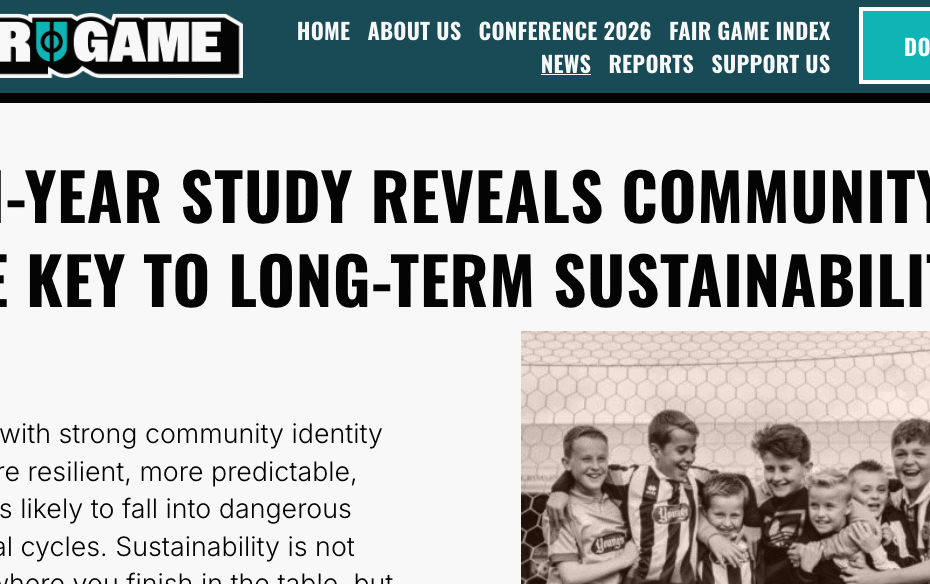
The FAB Culture Working Group wants to draw supporters’ attention to a new report published by Fair Game, a UK-based football governance think tank. Its findings strongly reinforce something Villa supporters have long understood instinctively: a football club’s long-term strength is rooted in its identity, culture, and community, not just league position.
About Fair Game
Fair Game is a coalition of football clubs, supporters, and experts campaigning for a fairer, more sustainable future for the game. Their work focuses on financial sustainability, responsible governance, equality, and community value, and they have been a key voice in shaping debate around football regulation in England.
This latest study adds robust, data-driven evidence to those arguments. You can read/download the full report here.
The Report: A Decade of Evidence
Fair Game’s report — A 10-Year Longitudinal Study: On-Pitch Success and Merchandising Income Across the English Football Pyramid — analysed ten seasons of financial and performance data (2014/15–2023/24) across ten clubs, including Aston Villa.
The headline conclusion is clear:
Clubs with strong community identity are more resilient, more predictable, and less likely to fall into dangerous financial cycles.
While promotions, European qualification, and star players do drive short-term spikes in commercial income, they do not create long-term financial stability on their own. Instead, clubs that invest in belonging, inclusion, and local identity are better protected from the financial shocks of relegation, poor form, or changing ownership strategies.
What the Study Says About Aston Villa
Aston Villa’s case study is particularly instructive.
The data shows a classic boom-and-bust pattern:
- Relegation led to sharp falls in merchandise income
- Promotion and European qualification produced major spikes
- Success rapidly reactivated spending from a large, historic fanbase
But the swings were steep. Even a club with Villa’s size, history, and global recognition remains exposed when financial health rises and falls primarily with results.
The lesson is not that success doesn’t matter — it clearly does — but that performance-led income alone is volatile. Without deeper cultural and community foundations, even major clubs remain vulnerable to cyclical risk.
Why This Matters to the FAB Culture Working Group
The FAB Culture team exists to help ensure that Aston Villa’s long-term future is built on more than short-term results. Our focus is on:
- Protecting and celebrating the club’s heritage and identity
- Strengthening belonging across generations and communities
- Supporting a culture that is inclusive, rooted, and resilient
- Ensuring supporter voice is embedded in how the club defines itself
Fair Game’s findings strongly validate this approach. The report shows that identity itself is a form of sustainability – not a “nice to have”, but a structural asset.
Clubs that understand who they are, who they represent, and how supporters connect to them financially and emotionally are:
- More stable
- Less exposed to boom-and-bust cycles
- Better positioned to weather change
In other words, culture is not separate from sustainability – it underpins it.
A Shared Direction
Fair Game argues that football needs:
- Fairer regulation
- Stronger cost controls
- Governance models that reward community investment, not just wealth
From the Culture Working Group’s perspective, this aligns closely with our own priorities at Villa. A club that invests in its story, its supporters, and its sense of place is not looking backwards – it is building a stronger future.
As the report puts it:
“Sustainability is not about where you finish in the table, but who you are and who you represent.”
That principle sits at the heart of the Culture Group’s work.
What Happens Next
The FAB Culture Working Group will continue to:
- Develop proposals that strengthen Aston Villa’s cultural foundations
- Champion heritage, atmosphere, and supporter identity
- Engage constructively with the Club on long-term cultural strategy
We encourage supporters to read the full Fair Game report and reflect on what it tells us about the kind of club we want Aston Villa to be – not just next season, but for decades to come.
Because culture isn’t an add-on. It’s the bedrock.
UTV — Prepared, one voice.